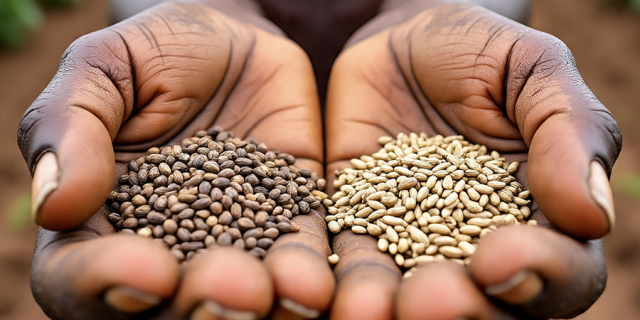
Yesterday, I attended a mid‑month meeting with a women’s group in Kahangi, Kabarole District, where they had invited me to share insights on group conflict. The session was lively, filled with laughter, thoughtful exchanges, and constructive debate. Just as I was preparing to leave, one of the members posed a question, that was totally off the day’s topic, and it kept me there for more than an extra hour: “What is the difference between the new and improved seeds?” That single inquiry shifted our conversation toward agroecology. Curious to hear their perspectives, I turned the question back to them, and what followed was a spirited discussion.
The women explained that indigenous seeds are the legacy of generations, saved and shared through rituals, storytelling, and community exchange. In Uganda, millet or sorghum seeds were often stored in calabashes, baskets, or clay pots, symbolizing continuity. They emphasized that such seeds are deeply rooted in culture and identity, “a tree without roots cannot stand.”… a member poined out. New seeds, they said, are born in sterile laboratories, disconnected from the soil and the stories that shaped traditional agriculture. Local seeds know the land like children raised in their mother’s home; they thrive in native soils and climates, adjusting naturally to seasonal changes, while new seeds are bred for specific conditions and often falter when exposed to unexpected weather or soil types.
They noted that indigenous seeds have built natural resistance to local pests and diseases over centuries. Maize varieties existent in the whole country, for example, resist weevils better than imported hybrids. New seeds may be engineered for resistance but often require chemical reinforcement:“the one who knows the forest does not fear the thorns.” Indigenous seeds yield moderately but reliably, while new seeds promise bumper harvests only when pampered with fertilizers, irrigation, and pesticides. Without these, their performance drops sharply. Cost was another dividing line: they said that the indigenous seeds are often free, saved from previous harvests or exchanged among neighbors …“what is given freely feeds the village.” New seeds, they observed, come with a price tag, often, unaffordable for smallholder farmers.
They reminded me that traditional seeds can be replanted season after season; farmers in Karamoja still dry and store sorghum in granaries for future use, while they have to buy new seed every season! New seeds, especially hybrids, are often sterile or legally restricted from reuse. Indigenous seeds reflect biodiversity, a single village may grow five types of beans, each with unique traits. New seeds are uniform, reducing genetic diversity and increasing vulnerability. Local varieties like finger millet and amaranth are rich in iron and calcium, while new seeds may prioritize appearance or shelf life over nutrition, “food is medicine when grown with wisdom”, they reminded me. Indigenous crops also carry robust flavors, with traditional maize for posho tasting richer than commercial hybrids. Seeds like groundnuts and simsim remain central to ceremonies and ancestral offerings, “a seed carries the memory of the people”, whereas new seeds lack cultural ties … “it is a visitor, and after a short while, it must leave“, one member went on to say with others nodding in unison.
The women further explained that local markets favor indigenous crops for taste and tradition, while new seeds dominate commercial supply chains. Indigenous seeds require careful storage and renewal, while new seeds are bred for long shelf life, favoring industrial logistics. Traditional seeds grow well with compost and natural rainfall, whereas new seeds demand chemical fertilizers and irrigation, straining both costs and ecosystems. Indigenous seeds have weathered droughts, floods, and heatwaves, while new seeds may collapse under stress, “the old goat knows where the rain hits hardest.” Local seeds are found in homes, markets, and seed fairs, and they belong to the people. New seeds are sold by companies, patented, and often priced out of reach for smallholders.
They concluded that indigenous seeds support agroecology, biodiversity, and community resilience. They are low‑risk, surviving under tough conditions, and embody centuries of farmer innovation. Farmers exchange them freely at weddings, funerals, and festivals, “a seed shared is a harvest multiplied.” New seeds, however, are sold under contracts, bred for speed, and often disrupt natural soil cycles. Indigenous seeds enrich the soil through deep roots and organic matter, survive on rain, and resist pests naturally. New seeds deplete nutrients quickly, require irrigation, and depend on chemical sprays and synthetic fertilizers, which pollute water sources.
Economically, they said, indigenous seeds keep money in the community, while new seeds funnel profits to corporations. Knowledge of traditional seeds is passed through storytelling and mentorship, while new seeds require manuals and training sessions. Indigenous seeds last for years, empowering communities to feed themselves, while new seeds expire quickly, forcing repurchase and dependency. Traditional farming supports birds, insects, and microbes, while new seeds reduce biodiversity and increase emissions through transport and chemical use. Seed banks and cooperatives promote indigenous seeds, while new seeds are pushed by commercial policies.
They described indigenous seeds as reflecting ecological innovation, farmer autonomy, and resilience. Farmers decide what to grow and when, storing seeds in gourds, baskets, or underground pits. New seeds come with conditions, contracts, and require refrigeration or sealed packaging. Traditional seeds vary in size, height, color, shape, and texture, adapting to local needs and cooking traditions. New seeds are standardized for machines, packaging, and shelf life. Indigenous seeds resist endemic diseases, allow flexible harvesting, and survive neglect, bouncing back when conditions improve. New seeds may resist one disease but be vulnerable to others, require synchronized harvesting, and fail without constant care.
Finally, they emphasized that seeds like Kinyangw’ekulu, a type of maize that is treasured for its unique flavour, textures, and adaptability to local conditions, native to the batooro, is part of community identity, while new seeds symbolize modernization but erase tradition. Indigenous seeds adapt naturally to changing climates, exchanged through trust and kinship, and remain viable across generations, “what feeds the child today must feed the grandchild tomorrow.” New seeds, however, need constant redesign, are distributed through formal channels, and depend on fragile supply chains.
Listening to them affirmed the enduring value of indigenous seeds, not just as agricultural inputs, but as vessels of culture, resilience, and ecological wisdom. Their preservation, they insisted, is not nostalgia; it is a strategy for survival. As one woman concluded, “a seed carries the memory of the people,” reminding us that safeguarding them is safeguarding our future.